
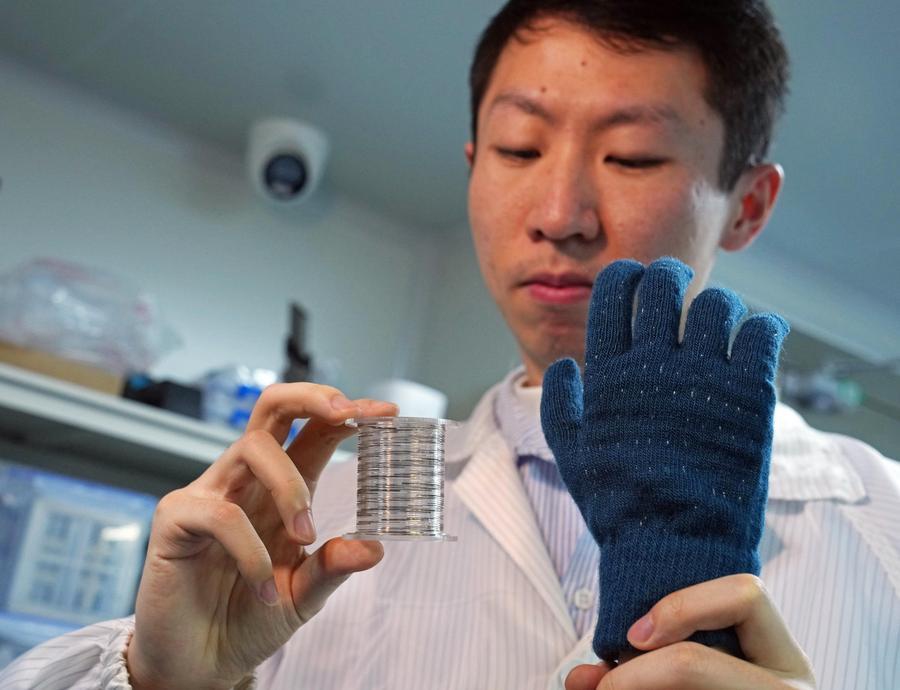
A researcher displays rolled “fiber chips” and a smart tactile glove made by weaving the chips together at Fudan University in Shanghai, east China, January 19, 2026. (Xinhua/Liu Ying)
As the global push for AI computing power has unleashed an unprecedented wave of infrastructure build-out, Chinese-made optical modules and the chips that transfer and process data have become critical links. With world-leading market shares and accelerated innovation, China’s technology supply chains have become vital to sustaining global AI growth.
The numbers speak for themselves. Chinese companies claim seven of the world’s top 10 optical module vendors, with a combined market share of more than 60 percent globally, according to LightCounting, a research firm. In the first four months of 2026, China exported 117 billion integrated circuits worth US$103.5 billion, an increase of 83.7 percent year-on-year. Export orders for optical modules extended to 2028
Behind these statistics lies a profound shift: China no longer participates in the AI supply chain, but provides a supply chain that underpins the global AI infrastructure.
Optical modules are first
If AI is the brain, optical modules are the nerves — the ones that convert electrical signals into light and transfer data at blinding speeds, within data centers and between servers across continents. A single 1.6-terabit optical module can transmit 95 high-definition movies per second.
Chinese companies are leading the market. Zhongji InnoLight, based in Yantai in east China’s Shandong province, has held the top spot for four consecutive years, with more than 40 percent of the global 800G optical module market and 50 to 70 percent of the 1.6T segment last year. InnoLight’s cross-provincial competitor Eoptolink in Chengdu, southwest China, took second place.
Both companies have secured their positions in the supply chains of companies creating AI clusters that are reshaping the global economy, such as Nvidia, Google and Amazon. Delivery cycles that once took 12 weeks have been shortened to eight or less, as North American customers have increased computing capacity calculated in weekly increments.
As of March 2026, China’s average export price of optical modules rose 23 percent year-on-year, while fiber and cable exports rose 263.8 percent in year-on-year value, with average export prices up 204.3 percent.
Huagong Tech, an optical module manufacturer based in Wuhan, central China, launched the world’s first 12.8-terabit XPO module in March, combining the capacity of eight 1.6T modules into a single unit to accommodate more than 100,000 GPUs for next-generation AI clusters.
Ma Xinqiang, the company’s president, noted that the North American market for 1.6T modules alone has exceeded US$20 billion, while the global market will exceed US$30 billion this year.
Chip Rise
Chip’s story is new but no less striking. China produced 127.2 billion integrated circuits in the first quarter of 2026, up 24.3 percent year-on-year, or about 14 billion chips per day.
High-value products have become a key source of China’s chip exports. In April alone, export value doubled to $31.1 billion, up 100.1 percent year-on-year, while export volume rose just 3.8 percent. Such a gap, rarely seen in China’s chip trade, indicates a systematic revaluation of export product value rather than simple volume growth, industry insiders said.
Among the country’s leading chipmakers, SMIC operated at 93.1 percent capacity utilization in the first quarter of 2026, while Hua Hong Semiconductor saw its net profit attributable to parent company shareholders grow 458.1 percent year-on-year to US$20.9 million.
Equally important is what happens on the equipment side. According to data from the China Semiconductor Industry Association, the localization rate of domestic semiconductor equipment has risen from 25 percent at the end of 2024 to 35 percent in 2025. Among new wafer-fab production lines, domestically-made equipment accounted for 55 percent of total procurement value, an official schedule to exceed 50 percent by the end of 2025.
Integration and regression
Optical modules and chips are not parallel stories, but converged. The same AI boom that’s driving insatiable demand for high-speed optical interconnects is reshaping the chip landscape: MOS memory sales rose 236.4 percent in the first quarter of this year, while sales of logic chips grew 40.1 percent, according to a recent report from European Semiconductor Association Indus.
The phrase “computer-power integration” entered China’s government work report for the first time this year, a CICC research report identified as a key industrial trend driven by rising AI demand and the transition to low-carbon energy.
The vehicle-chip nexus meanwhile adds another dimension. Each new energy vehicle contains more than 1,000 chips, twice as many as a traditional car. Chinese companies have outpaced foreign rivals in power semiconductors and made progress in cabin-entertainment and body-control chips, although high-end autonomous-driver SoCs are in the works, said Liu Guan, deputy chief engineer at the China Information Industry Development Center.
The competitiveness of optical modules depends heavily on the synergy of the complete upstream industrial chain, which includes optical chips, ceramic packages and precision structural components. China has developed highly concentrated industrial clusters in the Yangtze River Delta, the Pearl River Delta, and the Wuhan Optical Valley, where the localization rate exceeds 90 percent. This has enabled cost containment and mass-production yields to reach world-leading levels.
Zhang Xe, a researcher at the Electronic Information Research Institute under the China Academy of Information and Communications Technology, said the large-scale construction and expansion of AI data centers worldwide has created severe hardware demand.
While foreign manufacturers face supply-side constraints and limited capacity expansion, Chinese manufacturers, with adequate raw material supplies and the support of a complete industrial chain, can respond quickly to this round of demand bursts.
#optical #modules #chips #Chinas #technology #supply #chains #keeping #pace #global #growth