
With an estimated 1.2 million people with severe mental illness locked up in the nation’s jails and prisons, advocates continue to push for more options to move people into care instead of incarceration.
This month, the National Alliance on Mental Illness (NAMI) released a report calling on states to do more to keep people with mental illness out of prison and to invest more in taking care of the mental health needs of those already there. The report points to Tristin Murphy’s Law, a 2025 Florida law named after a man who died by suicide in a Florida prison.
The law strengthens diversion policies in Florida by expanding grants to train 911 operators and emergency medical technicians on crisis intervention. It also allows jails to screen people charged with crimes for mental illness 24 hours after being booked and provides an alternative option to jail, according to the brief.
“We hope to shed light on the tragedy that results from the overincarceration of people with mental illness,” Stephanie Pasternak, director of state affairs at NAMI, told MindSite News in an email. “We also want people to understand that these problems can be prevented with the right diversion policies, which can help people connect to the care they need.”
The report highlights the high number of people with mental illness who are incarcerated – 40% of people in jail or prison have a history of mental illness. It also points to legislation in Oklahoma, Nebraska, Washington, Minnesota, Colorado, Texas and Oregon as further examples of ways to keep mentally ill people out of prison.
The legislation broadly focuses on six categories: diversion, juvenile justice, conditions in custody, re-entry, restoration of competence and civil commitment.
“State lawmakers and advocates can use this brief to identify promising laws from other states that they would like to emulate to help reduce the criminalization of mental illness,” Pasternak said.
MindSite News interviewed Pasternak to learn more about NAMI’s recommendations. The interview has been edited for brevity and clarity.
Josh McGhee: Why did you choose to highlight Florida?
Stephanie Pasternak: Tristin Murphy died by suicide in a Florida prison in 2021 after the prison failed to identify and treat his mental illness. NAMI advocates are often used to bring the stories of the lived experiences of peers and family members before policy makers. In this case, NAMI advocates in Florida worked with Tristin Murphy’s family and other advocacy groups to bring Tristin’s story to the attention of the Florida legislature, governor’s office, and local media. (Editor’s note: CBS Miami produced the documentary, Warehoused: The Life and Death of Tristin Murphy).
Prison suicide is a national problem – suicide is the leading cause of death for people incarcerated in prisons, accounting for about 30% of all prison deaths. The Tristin Murphy Act (SB 168) improves mental health screening in jails. It also makes it possible for people arrested for non-violent offenses to be eligible for mental health diversion programs that can connect them to treatment and help them avoid prison.
The reality is that many mentally ill people who are incarcerated are arrested for non-violent crimes, minor offenses related to the symptoms of untreated illness (for example, disorderly conduct, loitering, trespassing, disturbing the peace) or for offenses such as loitering and petty theft. Arresting people for these low-level crimes is not only counterproductive and harmful to individuals and families, it is also very costly to state governments.
Current data tells us that at least 27 states have pre-trial diversion. But even for countries with pre-trial diversion, this program can and should be strengthened.
You talked a lot in the report about the “Sequential Intercept Model” – can you elaborate and why is it important?
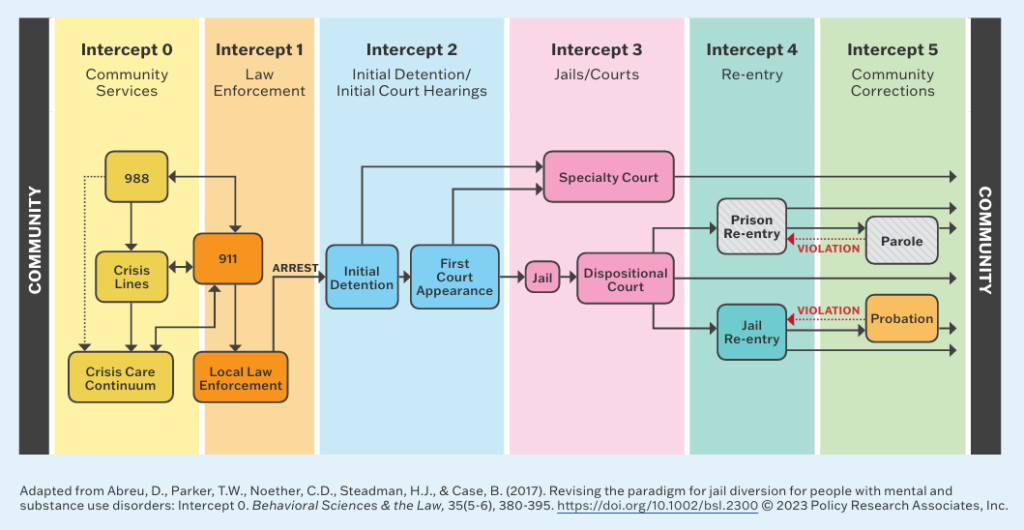
The Sequential Intercept Model (SIM) is an evidence-informed tool that helps communities identify opportunities and resources needed to help people with mental illness away from the justice system and into mental health care.
SIM includes five intercepts, starting from Intercept 0 (which refers to community service aimed at preventing any criminal justice system involvement) to key intercept points along the criminal justice system continuum (including law enforcement contact, first arrest/detention, prison and court, reentry, and community corrections).
We have focused on this model because it is a useful way for policy makers to understand where they can make a difference with the laws they introduce. States should have policies that provide diversion at every intercept.
Is it more beneficial to focus on expanding early intervention or improving things on the first intercept, before engaging with law enforcement?
NAMI strongly believes that the best solution to divert mentally ill people away from the involvement of the criminal justice system is through early intervention, comprehensive community mental health care, and a strong crisis response system.
NAMI wants everyone served at Intercept 0, before they have contact with the justice system. However, we cannot ignore the fact that many people do not receive a diagnosis or have access to treatment until they come into contact with the criminal justice system. Although mental health services are growing, our mental health system is far from perfect and law enforcement regularly encounters people with mental illness.
This reality means we must have the right policies in place to ensure that any contact with law enforcement or the justice system results in people gaining access to treatment and not being trapped in the cycle of incarceration.
This summary is the first of three that NAMI will publish this year. In May and July, we will focus on a more upstream approach with specific problem briefs for access to care and 988 and crisis response respectively.
What would you say to communities that are hesitant to involve the police in their model of care?
There can be hesitancy to involve the police in planning for a mental health crisis response, and it is understandable if the involvement of the police sometimes leads to tragic consequences. Despite the importance of reducing the role of law enforcement in mental health crisis response, they are currently the primary responders to mental health crises in most communities. Their knowledge of local systems, services, and trends can be important in identifying gaps and opportunities.
In addition, there may also be instances where law enforcement will need to be part of the crisis response, so getting their buy-in first helps.
People with severe mental illness are often deemed by the courts to be incompetent to stand trial or assist in their own defense and end up in jail awaiting mental health assistance to “restore competency.” What are your suggestions on this?
One of the biggest problems with competency restoration services is that they are designed to ensure people can understand the criminal charges against them and can participate in their own defense, rather than actually treating their mental illness. Because of this, even if individuals are restored to competence, we see them cycle back into prison because they still haven’t received adequate mental health treatment.
This is the reason why NAMI supports community-based competency restoration, provided by community mental health care providers. By connecting others to care in the community, providers can address both competency and long-term recovery. This sets others on the path to remain involved in their care and can eliminate care disruptions when someone flows from the justice system back into the community. The faster we can connect people to consistent services in the community, the greater the chance they have to stay engaged in long-term recovery.
MindSite News has reported on people are involuntarily committed when they do not believe they are a danger to anyone or in a mental health crisis. How do we ensure that the law that expands the standard of commitment is not abused by the family or law enforcement?
The civil commitment system is broken. Laws that are written too narrowly mean that too many people fall through the cracks and end up in the cycle of homelessness or incarceration. Broadly written laws harm people whose civil rights are not violated. At NAMI, we advocate a balanced approach to reform – protecting individual rights but also allowing the system to intervene when necessary.
Having a policy that enforces strong process protections is essential. The law must be clear about what qualifies someone for commitment, who can initiate proceedings, timeframes for initial commitment and court proceedings, access to legal advice, the right to several independent evaluations, and regular redetermination hearings – all are measures that can help protect the law of commitment from being abused.
Courts and the mental health system must work together as close partners to ensure commitment is only used when clinically necessary and the individual rights of others are not disregarded.
#NAMI #Pushes #Law #Transfer #Mental #Health #Patients #Jails