

When Eric Mosinger returned home after visiting the Getty Museum in Los Angeles, he wanted to continue exploring. Time spent in the galleries was not enough.
This isn’t the first time he’s sought out a virtual museum experience. Years ago, after purchasing an Oculus Go, he immediately sought out a VR version of Google Arts & Culture. Google Arts & Culture has already made millions of artworks available online, and he assumed a VR version would come eventually.
“I said, ‘It’s okay. They’ll release it soon,'” he recalled. “Then I got Quest 2, and they didn’t have it.”
Eventually, he decided to create the museum experience he wanted himself.
“A museum is a cube with JPEGs on the walls,” he joked. “How hard would that be?”
“It turns out that it’s very difficult.”
Fortunately, she added, “I’m pretty stubborn.”
That idea eventually grew into ArtQuest VR, one of VR’s most ambitious virtual museums. Its latest expansion adds two new DLC collections, Sculpture & Decorative Arts and Ancient Art & Archaeology, bringing more than 1,400 prehistoric three-dimensional sculptures and artifacts into the modern era.
If you’re new to ArtQuest VR, you can also read our previous impressions that take a closer look at the app’s core museum experience.
Collections are drawn from digitization projects and publicly available scans from institutions including the Louvre Museum, The Metropolitan Museum of Art, the British Museum and the Pergamon Museum.
He built a museum that could not be found
Mosinger is not a professional game developer. He is a university professor who has learned enough unity to create an undiscoverable museum experience. ArtQuest grew out of a simple desire to spend more time with artworks that inspired him during museum visits.
The Getty Museum, in particular, made its mark on the app. The default gallery inside ArtQuest is modeled after one of the museum’s Impressionist galleries, complete with gray walls and skylights.
His initial prototype used artwork from Google Arts & Culture before he realized he couldn’t use those images in a publicly distributed app. He recreated the project using public domain artwork from Wikimedia Commons, gradually expanding the collection while learning about integrity and everything needed to create a virtual museum.
Adding sculpture required a completely different workflow.
Unlike paintings, which can often be acquired through public domain archives, sculptures and archaeological artifacts must be collected separately from museum digitization projects and public photography collections. Each model required careful optimization before running smoothly on separate Quest hardware.
Many scans start with millions of polygons.
“A maximum of 150,000 polyps should be destroyed without destroying them completely,” explained Mosinger. “You can see a model or image on a computer screen with a resolution that’s really good. When you’re in VR, you can get it right, and all of a sudden it takes you out of VR.”
Mosinger doesn’t import everything he finds. He manages each addition himself, checks licenses, assesses scan quality, adjusts models when necessary, and determines whether each piece meets the standards users want to experience.

Seeing art a little differently
Spending time at ArtQuest has changed the way I look at paintings.
I kept stretching in front of works I might have passed by in a museum. Walking up to a canvas, I was able to study the individual brushstrokes, the superior structure layered over centuries, and the subtle weave of the canvas beneath. Those are the details I never noticed before.
Mona Lisa is a good example. While there’s no substitute for seeing an original, ArtQuest offers something that museums often can’t: the ability to spend as much time as you like quietly with a painting, without crowds, glass barriers, or the pressure to keep moving.
I look at paintings in my “favorites” gallery
New sculpture & decorative arts and ancient art & archeology collections extend that experience beyond paintings. The range is impressive, from small carved figures to full-scale sculptures by Michelangelo. David and monumental archaeological works such as the Temple of Tendur. You can explore at your own pace by walking around multiple sculptures or set them to rotate, making it easy to study every angle without having to move around your play space.
Whether I’m studying a painting or poking around a centuries-old sculpture, I find myself spending more time on each task than I usually do.
Mosinger laughed when I described the experience.
“That’s what I wanted to accomplish.”
See Ancient Art and Sculpture
Designed for curiosity
Although ArtQuest naturally appeals to museum enthusiasts, Mossinger hopes it can also reach people who aren’t interested in art.
“I think one of the things that ArtQuest does is when a teenager stops playing Gorilla Tag and starts thinking about what else they can do with Quest, they can look at it and say, ‘Hey, that’s something to watch.'”
Early in development, Mosinger recruited his parents, in their seventies, to test the app.
“I experimented on my parents,” he laughs.
His father spent eight to ten hours working through the interface within ArtQuest, pointing out anything that wasn’t intuitive. That feedback has helped refine everything from sitting gameplay to motion controls.
According to Mosinger, as ArtQuest found its audience, the elderly became one of its largest user groups. Today, at least one library in France uses the app as part of an art appreciation program.
Multiplayer support enables families and friends to tour galleries together, and Mosinger said some users continue to meet on ArtQuest even if they live hundreds of miles apart.
Asked what comes next, Mosinger said he’s more interested in helping people discover art than adding a virtual guide.
“Commonly requested features include navigation,” he said, pointing to search tools and better options for surface-related work. He also wants to see museum curators eventually conduct live guided tours inside virtual galleries.
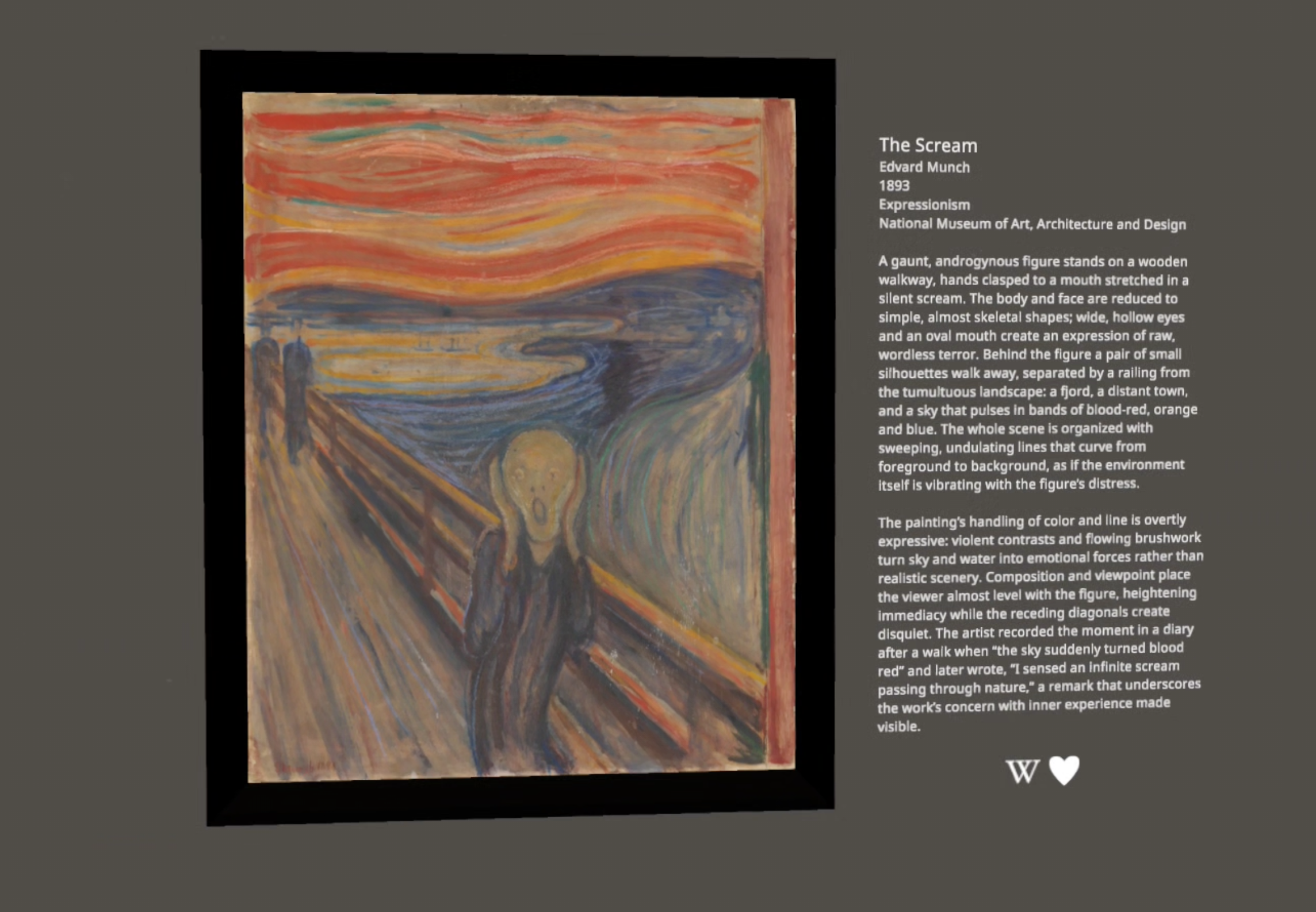
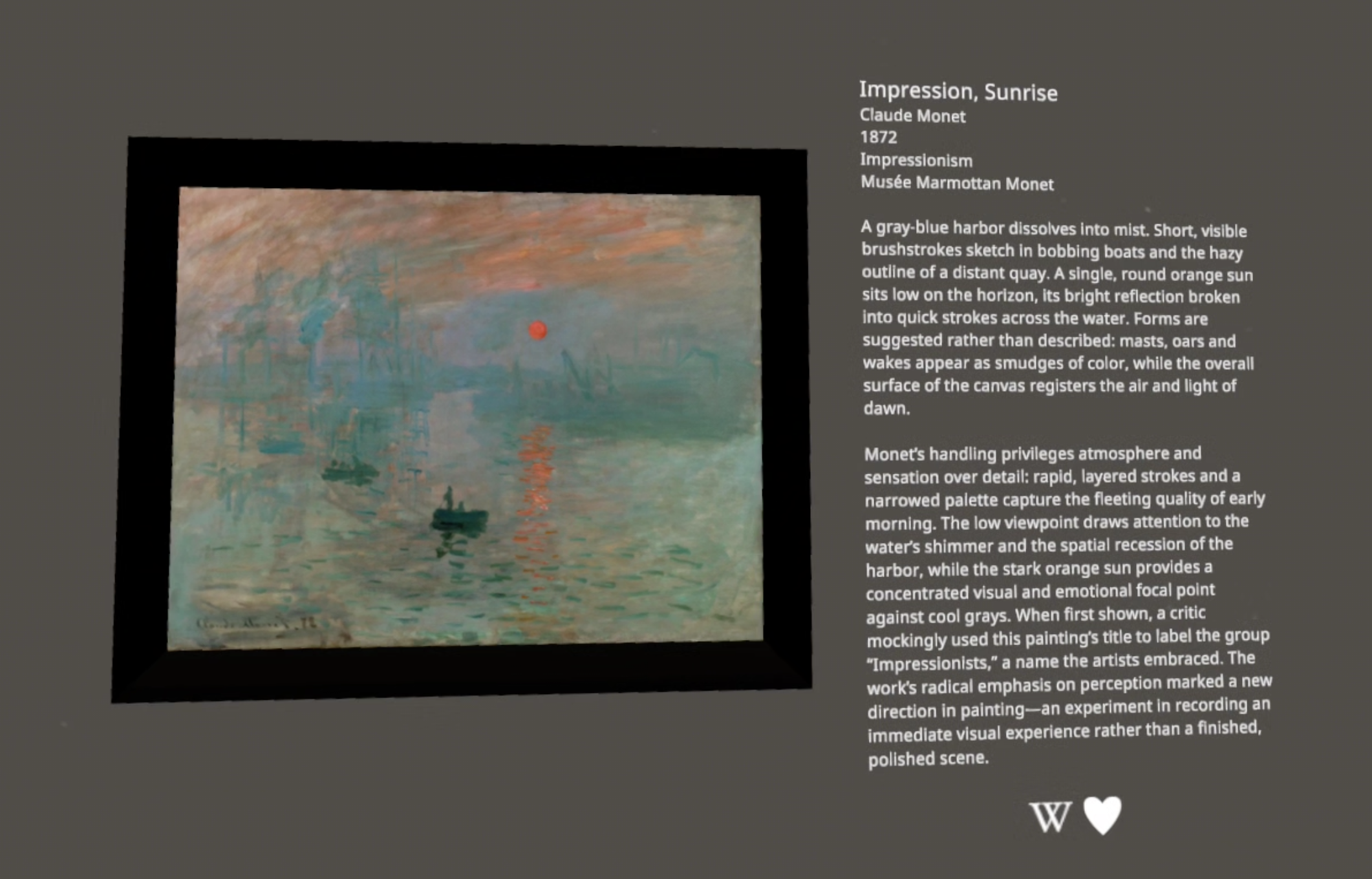
Munch and Monet, inside ArtQuest VR
Searching the holodeck
Eventually, our conversation moved beyond ArtQuest. Mosinger reflected on some of VR’s earliest educational experiences, many of which are no longer available in their original form.
For him, VR represents something ever closer Star TrekHolodeck than another game console.
“I’ve always imagined VR as a holodeck,” he said.
Authentic museum visits that inspire
After spending time on the app, I told Mosinger that I wanted to visit art museums more often.
He smiled.
“The best thing anyone can tell me about ArtQuest is that they used it and loved it, and then they went to a real-world art museum,” he said.
“That’s what I want more than anything else.”
ArtQuest VR is available in the MetaQuest Store for $9.99. The new DLC collections are available individually for $4.99 each or as a bundle for $7.99.
#ArtQuest #VRs #Ambitious #Virtual #Museums