Working the night shift is brutal. Circadian rhythms are disrupted, backup help in true emergencies is limited, and even simple things like labs or imaging can take longer than they should. But one of the biggest challenges is late-night snacking.
There’s something about the combination of darkness, fatigue, and intermittent slow periods that makes it ridiculously easy to inhale a two-pound bag of potato chips without thinking twice. Studies have shown that sleep deprivation alters ghrelin and leptin levels, increasing hunger signals while suppressing satiety. Add a long night shift, and no wonder weight gain is common for night shift doctors.
I had heard a lot about intermittent fasting, with some people narrowing their “eating window” to be as little as six hours. I want something more practical. So I made a simple rule: No eating from 8:00 pm to 1:00 am Other than one rule, I made no changes in my diet or lifestyle. Water, coffee, and diet soda are allowed during the fasting window.
I anticipated that the initial changes would be subtle, so I started with a weekly weigh-in. After two weeks, I switched to weighing myself every day, always at the same time, on the same scale, in the same place on my bathroom floor. Data was collected over eight weeks.
Yields and day-to-day volatility
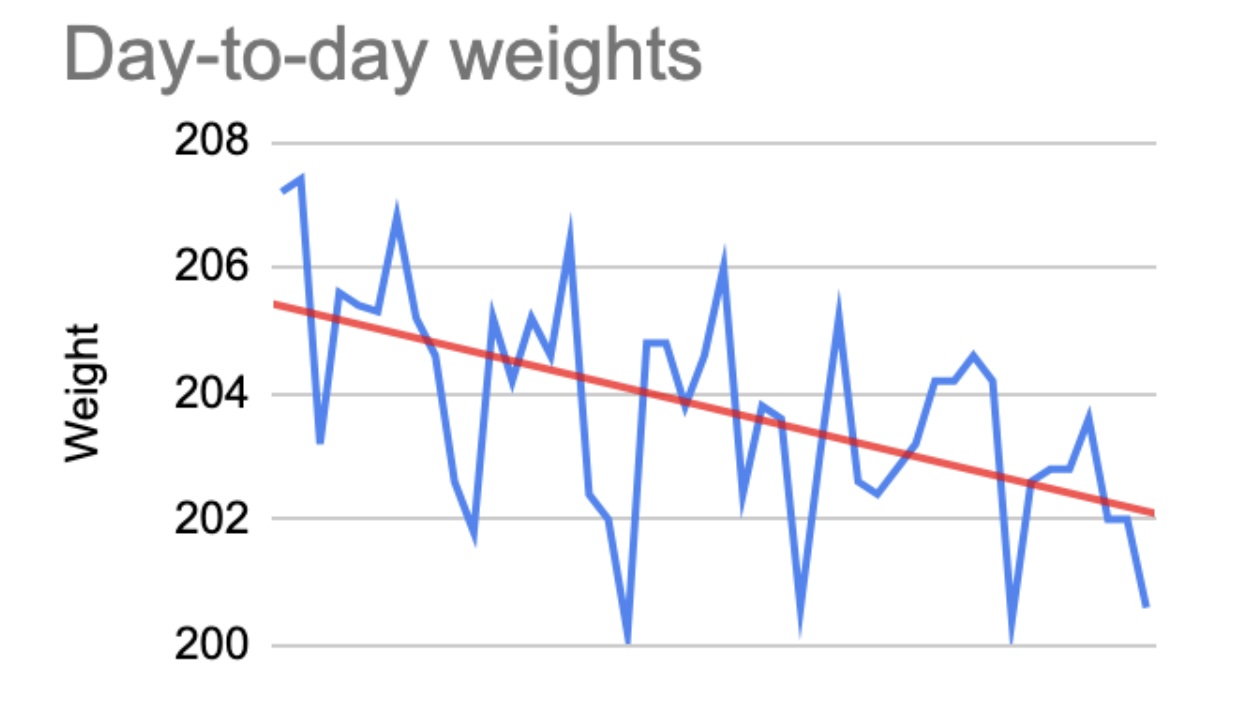
Approximately 40 weighings were recorded during the study period. Daily weight fluctuated significantly, sometimes by several pounds from one day to the next. Frustrated? Very true. Expected? Also yes. These swings likely reflect normal physiological variations, such as fluid shifts, glycogen storage, sodium intake, and gastrointestinal contents, rather than true changes in body fat.
Soft weight trend
To better understand the underlying trajectory, a seven-day rolling average is calculated:
- Late December: ~207.2 lbs
- Early January: ~ 205 to 206 lbs
- Mid January: ~ 203.5 to 204.5 lbs
- Early February: ~203.0 lbs
- Late February: ~ 202.3 lbs
The overall change shows a starting weight (average end of December) of ~ 207.2 lbs and an ending weight (average end of February) of ~ 202.3 lbs. This resulted in a net loss of ~4.9 lbs, at a rate of ~0.8 lbs per week.
Interpret the data
When accounting for day-to-day variability, the trend is clear: Weight is steadily decreasing over time. This happens with only one intervention, eliminating late-night caloric intake. No diet overhaul. There is no new exercise regimen. There is only consistency.
I’m not surprised that the mix works. I was surprised by how volatile the daily numbers were. It takes grit to stay steady in the morning when the scale suggests I’ve gained four pounds overnight. Yet the nails did not remain. On the contrary, sharp short-term drops are often followed by partial rebounds. Over time, however, each subsequent baseline trended lower than the previous one. The overall pattern resembles a ladder down, temporary fluctuations layered over a clear decline.
Psychological shift
Despite its simplicity, this regimen is not easy. At 11:30 pm, the ER soundtrack will be on, adrenaline will be pumping, and the urge to snack feels almost automatic. Sometimes I say to myself: “Wait until 1:00 am. You don’t have to eat now.” Other times, I rely on coffee, water, or diet soda to bridge the gap. Some nights, I came close to breaking the rules. But consistency mattered.
And there is something interesting: after a few days, the fasting window becomes easier. The urge is not lost, but it can be managed. I feel more in control of my eating, rather than the other way around. Maybe the critics are right; maybe I just move the calories to a different window. But that “shift” is the point. By removing food from the most vulnerable hours, I eliminate the habit that causes excess intake.
Takeaways for night shift doctors
- Late-night eating is a significant contributor to weight gain, even small reductions.
- Simple rules outperform complex diets.
- Consistency is more important than perfection.
- daily weight fluctuations are normal; focus on trends, not single data points.
- The hardest moments are often psychological, not physiological.
Aaron Grubner is a pediatric emergency medicine physician.

#Night #shift #weight #loss #practical #fasting #guide #doctors