Texas retailers and nonprofits have spent months preparing for new restrictions on major food assistance programs that will go into effect this week – changes that could affect 3.5 million Texans.
People using Supplemental Nutrition Assistance Program, or SNAP, benefits will be prohibited from buying “candy or sugary drinks” starting Wednesday. While the state has published guidance online, some recipients may not know about the new restrictions until they check in stores.
Gary Huddleston, a grocery industry consultant for the Texas Retailers Association, said it’s up to stores to prevent customers from purchasing prohibited products with their SNAP benefit card, also known as the Lone Star Card.
“It’s common for wholesalers to ‘block’ products in the program,” he said. “The challenge is that there are some costs involved in making sure that the system is right.”
SNAP provides financial assistance to low-income families across the country. Texas is one of 22 states to implement a ban on “the purchase of non-nutritive items such as soda and candy.”
The restrictions are part of the Texas “Make America Healthy Again” initiative that Governor Greg Abbott signed into law last year.
What does this mean for Texans?
Huddleston said there won’t be many changes in the process for customers.
“The only problem is if they … don’t know that starting April 1, those two categories are exempt, and they’re taking stuff that they normally buy with a SNAP card and it’s not eligible,” he said.
Huddleston said most SNAP recipients know there are restrictions on what you can buy with the Lone Star Card and the state has been informing recipients about the changes.
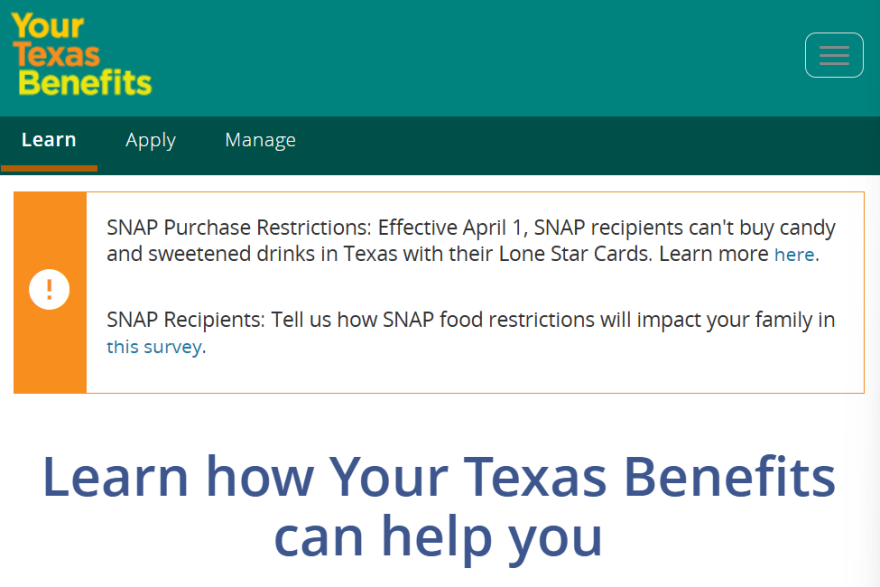
Tonya Edwards, senior director of SNAP and social services assistance with the North Texas Food Bank, said the state will typically put notices on websites that recipients use to check eligibility and benefits.
Screenshot of your Texas Benefits website
“Open Your Texas Advantage,” Edwards said. “It will always provide [recipients] with the most updated information on what is happening or what is changing with the benefits.
Clarisa Clarke, government relations office for the North Texas Food Bank, said the changes haven’t been publicized much beyond the national level — which means some SNAP recipients aren’t aware of the upcoming changes.
“Unfortunately, I think people will find out when they go to the store,” he said. “I don’t know how much awareness there is out there.”
Huddleston said cashiers and store employees will play a big role in explaining what that means for customers.
However, some SNAP shoppers may not have access to large grocery stores like Kroger. Clarke said she and the leadership of the North Texas Food Bank are concerned about the impact on communities considered “food deserts.”
“Like in south Dallas, where people don’t have access to nutritious food, big grocery stores, those things, and they have to shop at convenience stores,” Clarke said. “It’s going to limit the options for what they can buy…because obviously a lot of convenience stores, they don’t have fresh produce and protein.”
Clarke said it takes time for people to figure out what’s allowed and what’s not — especially because some people don’t realize how sugary some products can be.
“It’s going to be a little bit of trial and error,” he said. “But actually, from what we’re hearing, most people use their SNAP benefits for fresh produce [and] protein, because it’s a more expensive item.
Edwards and Clarke both highlighted the importance of community resources to support SNAP recipients — especially at times when they have questions or need resources. The North Texas Food Bank said it can support families concerned about the change by providing food assistance, answering questions about the change and providing information about additional community programs for people to use.
Starting April 1, Texans will no longer be allowed to use food stamps to buy soft drinks and candy.
How do retailers determine what is prohibited?
There are always products that SNAP does not apply to, such as prepared foods, alcohol and non-food products – such as tobacco and drugs. However, this is the first time since the federal program began in the 1960s that the state has placed additional restrictions on what recipients can buy.
“This new ban is for just two categories of food products: sweetened beverages and candy,” Huddleston said. “The main thing is to make sure that we have the right products blocked in every supermarket according to the definition.”
There are a lot of questions about the category and what it means for retailers, Huddleston said. He said the grocer has been meeting with the state regularly since the beginning of the year, as well as participating in bi-weekly calls and webinars.
For example, the country defined “sweet drink” as a drink made with water that contains five or more grams of added sugar per serving or the amount of artificial sweetener – knocking out most of the line of typical drinks.
Texas Health and Human Services said recipients can still purchase milk or milk substitutes, as well as beverages that contain more than 50% vegetable or fruit juice, contain natural sweeteners with less than five grams of sugar and added electrolyte drinks to treat dehydration that are not labeled as “sports drinks.”
The country defined candy as candy bars, gum and taffy. It also includes nuts, raisins or fruits that have been “candied, crystalized, glazed or coated with chocolate, yogurt or caramel”.
Even by definition, some grocers have concerns about what products will be affected.
“The state has a specific website that … a grocer can go to and ask that question on a specific product to make sure that specific product is eligible or not eligible,” Huddleston said. “There’s been some discussion about nutrition bars, some discussion about a new probiotic drink. So, it’s all been worked on and worked on.”
How has the store prepared?
Retailers must go through their point-of-sale systems and determine which products qualify for SNAP and which do not.
Huddleston said the process can look different for different companies depending on their size. For example, a large grocer, like Kroger, is typically more used to making changes in their system. He said there may be some costs involved, but not as much as what small grocers may have to take on.
“I wouldn’t say it’s more difficult, maybe a little more time consuming and it might be more expensive for small retailers because they have to hire outside programming or outside help,” said Huddleston.
He said, once the store has a list with prohibited items, it is not the time to act.
“The time-consuming part is going to be at the checkout when the customer asks, ‘I used to be able to buy this with my SNAP card, my Lone Star card, and now I can’t,'” Huddleston said. “Then the inspectors explain why they can’t do it… .Supermarkets will carry out training to ensure that the inspectors know and have adequate knowledge to explain it to customers.”
In addition, many stores will post signage to help consumers understand the new rules when they shop.
“The state has given each store the verbiage for consistent signage across the market,” said Huddleston. “It can be a bit expensive in the production of signage, but not much. It ensures that it is ready for April 1.”
What happens when retailers make mistakes?
The state will allow a 90-day grace period for retailers as they adjust to the new restrictions. If the store does not obey the ban, even if it is accidental, they can receive a penalty.
Huddleston said the state is still working out who is responsible for monitoring the store and what the punishment will be.
While the implementation has implications for retailers, Huddleston said the program is critical for many grocers — especially in areas with large numbers of SNAP recipients.
“This is something that supermarkets support and know that many customers need SNAP benefits,” Huddleston said. “We’re going to try and make it easier for them to use their SNAP benefits.”
Abigail Ruhman is KERA’s health reporter. Got a tip? Email Abigail at aruhman@kera.org.
KERA News is made possible by the generosity of our members. If you find this reporting valuable, consider it make a tax-deductible gift today. Thank you.
#Trial #error #Texas #community #organizations #retailers #prepare #state #implements #SNAP #ban