
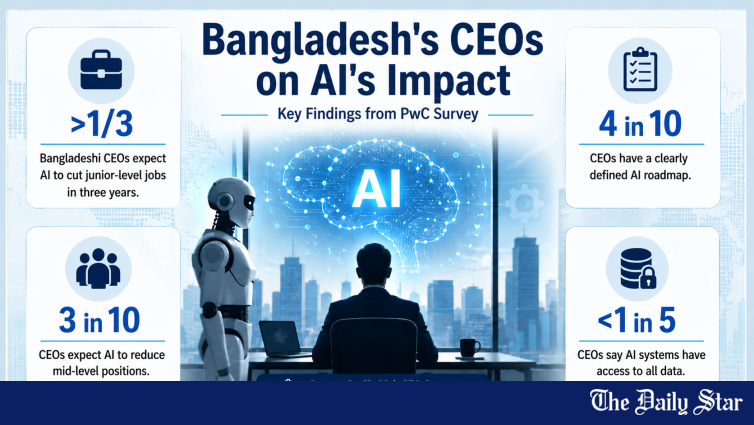
According to a recent PwC report, a third of Bangladeshi CEOs expect artificial intelligence (AI) to cut junior-level jobs in the next three years.
This compares to 43 percent in Southeast Asia and 49 percent globally, indicating a relatively more cautious outlook in Bangladesh.
The findings are part of PwC’s 29th CEO survey — Bangladesh edition, which showed that three in 10 CEOs expect AI to reduce mid-level positions in line with global trends.
However, with only a small percentage expecting cuts in senior-level roles, AI is more likely to augment leadership than replace it.
The survey is based on PwC’s global survey of 4,454 CEOs in 95 countries and regions, including 45 from Bangladesh. It was conducted from September 30 to November 10, 2025.
The report says Bangladesh is still in the early stages of scaling AI across organizations, with adoption limited in most business functions. While companies are actively experimenting with AI, it is not yet deeply embedded in core operations.
“Business leaders are no longer debating whether they need to reinvent themselves, but whether they are doing it at the right pace and with the expertise needed to be viable in the future,” said Shams Zaman, country managing partner, PwC Bangladesh.
Bangladeshi companies report relatively stronger AI use than their Southeast Asian counterparts in selected areas such as demand generation, support services and strategic decision-making.
One in five CEOs say their companies use AI for demand generation and direction setting, a higher share than regional peers.
However, Bangladesh still lags behind the global average in areas such as support services and the development of AI-enabled products, services and customer experiences, where global adoption is only one-fifth.
PwC points out that the main challenge is not a lack of regional efficiency, but scaling AI across organizations.
“To move beyond pilot projects, Bangladeshi companies like ours must first get the basics right — a clear AI roadmap, robust data systems and governance structures tailored to our local environment,” Asif Bhuyan, Group CEO of AK Khan & Company Ltd. said in the statement.
Survey results highlight this gap. More than four in 10 CEOs say their organizations have a clearly defined AI roadmap, while less than one in five report their AI systems have access to all relevant enterprise data. This places Bangladesh behind regional and global peers in key AI readiness.
Only a small share of organizations have established a formal responsible AI and risk management framework. One in five CEOs believe current AI investment levels are sufficient to meet their goals.
The preparedness gap is visible in the product as well. While AI adoption is in its early stages, executives see strong potential in predictive maintenance, quality control and supply chain visibility as global buyers demand greater speed, transparency and compliance.
“AI adoption in Bangladesh is still in its infancy, but there is strong potential in areas such as predictive maintenance, quality control and supply-chain visibility,” said Sharif Zahir, managing director of Ananta Apparels Ltd, adding that global buyers are demanding greater efficiency and accountability.
Despite these gaps, the report highlights some positive signals. Nearly 64.1 percent of CEOs say their organizational culture supports AI adoption, while 58.9 percent say their technology environments are capable of integrating AI.
Grameenphone CEO Yasir Azman said companies are now balancing efficiency gains with broader strategic priorities.
“The integration of AI into core operations is no longer optional – it is essential to improve efficiency and create new growth opportunities. At the same time, sustainability, risk preparedness and climate resilience must be central to our strategies,” he said.
In terms of financial effects, 20.5 percent of CEOs report that AI has increased revenue in the past year, and 25.6 percent have decreased costs. However, these gains have been concentrated among a small number of firms rather than being widespread.
Concerns about AI security are relatively low in Bangladesh, with only 4.4 percent of CEOs reporting a high or very high level of concern, compared to a global average of 13 percent.
#local #CEOs #expect #cut #junior #jobs #PwC